Steam, The Trojan Horse of Linux Gaming
Author: Jonathan Vasquez <jon@xyinn.org>
Last Updated: 2026-10-12-1200
Originally Posted: 2026-10-12-1200
pub fn main() !void
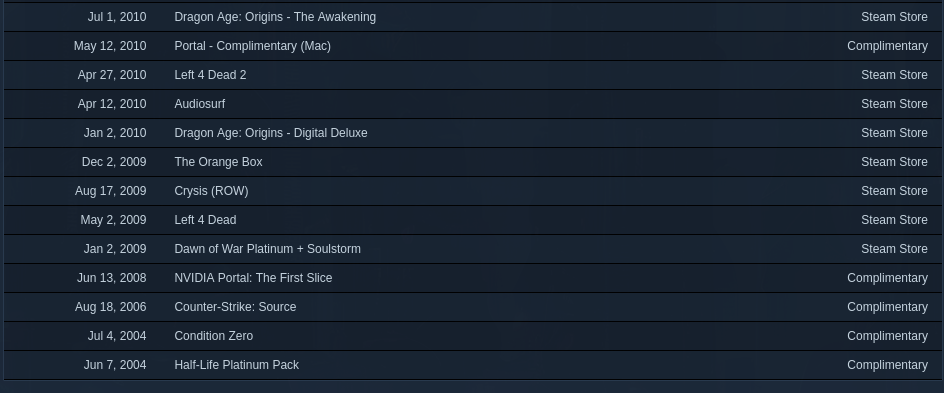
Three years ago, I wrote a blog post called Going Dark in Windows - An Offline Single Player Gaming PC which goes a bit into my childhood, how I experienced gaming and the internet back then, how that environment led to a world where we could actually purchase and own our games, and concluding with my method for happily isolating my gaming experience from the ridiculousness of the modern gaming scene. I highly recommend checking it out. In that blog post I also touched upon Steam, how I was a big supporter and one of its first users in early 2004, and showing the below screenshot which shows my first imports of my Half-Life / Counter-Strike CD Keys into the Steam platform. Given that at the time of import I was only 13 years old (born in 1991), little would I know the implications of my actions and what that would eventually lead to as the decades continued.
Starting in 2006, I slowly started learning about the Open Source and Free Software movements, with the main operating systems I tested at the time being Ubuntu 6.06 / 6.10 (Dapper Drake / Edgy Eft), Fedora Core 5 / 6 (Bordeaux / Zod), and OpenSUSE 10.3. Eventually over the years making my way to Arch Linux, Gentoo Linux, Linux from Scratch, and FreeBSD. Piece by piece, as Microsoft and other proprietary companies continued to take negative actions towards the user base, and as government surveillance continued to increase globally, I transitioned all of the components I would use in my personal life from proprietary applications to open source alternatives. Not that I'm fundamentally against proprietary software, I believe for some types of application categories, proprietary applications are fine (such as gaming). What I was more concerned with was the privacy, security, and ownership of it all, living my life and taking actions on my own time frame, rather than at the time frame of an external entity. We all live within a system and we are all interconnected and interdependent, so there is only so much one person alone can do, but an individual still has a huge amount of control over what they can do in their own life, specifically by understanding that you can't control anything other than your response to what is coming your way. Understanding all of this, things continued to improve in my life, deleting all of my social media profiles in 2016, essentially using mostly open source applications and an open source platform for my day to day living, and having an offline Windows 10 gaming machine that isn't subject to spying, telemetry, forced data collection, not needing to worry about Windows' EOL status, using that windows 10 gaming machine the same exact way as I used the rest of my traditional consoles. NES, SNES, N64, PS1, PS2, Gameboy, etc never needed an internet connection, and still don't today. My offline gaming computer is just that, a Wintendo, an offline gaming console. My solution has been working beautifully for years and will continue to work for years because the foundation is solid. Only playing Offline Single Player DRM free games (or games that have old DRM technology that can easily be removed / bypassed like SecuROM), not buying any games that don't work on Windows 10 (or below), works for me and for what I'm interested in spending my time on. Giving that my time is extremely limited, and I already actually own more than 300 games across multiple platforms, I already don't have the time to play and re-play all of these games, why would I spend my money buying a new modern game that I don't own and that can be taken away from me when I could buy a game from the thousands of beautiful games produced by humanity over the past 30-40 years that I actually do own? (Shout out to Larian Studios and Baldur's Gate 3, I pre-ordered it just to support them and still haven't played it deeply but will do so for sure).

All of this leads to Valve and Steam. The open source community (the people, not necessarily the corporations trying to influence projects through monetary means) has had a clear guiding principle of the types of technologies we want to exist in the world and the way that we want those technologies to exist and be developed. However, for whatever reason, it seems the community is perfectly fine accepting Steam into our world as is. Not only is Steam a proprietary application and platform, but it's specifically a platform that will remove your ownership. Do I believe that Valve is doing a lot of good in the Linux gaming scene by developing and sponsoring technologies such as Proton (Wine+), FEX, etc? Of course. This is extremely valuable and important work for gaming preservation, however Valve's motivations for doing all of this work is not for preservation, they don't care about that. The important thing for them from a business perspective is that all of these games that are being developed for Windows can work on a different platform that they have more control over, which in this case is Linux. They have taken an open source technology, developed it to develop SteamOS which is open, but then the entire gaming layer is completely proprietary and locked down, with all of the games on that platform being locked down as well (Steamworks isn't enabled for all games but it's enabled for most and there is no public way to just filter and buy games on Steam that are DRM-free and can work without the Steam client). This is the same exact tactics that Google did with Android. AOSP is open source, but all of the gapps, Google Play Services, etc are proprietary. For people interested in actual openness and ownership, SteamOS is a Trojan Horse in the community. Us in the open source community are being attracted to an open operating system platform that ultimately is designed to remove the ownership we have over our games. If we support this, we will fully lose the last remaining control that we have over them. People may say that since SteamOS is open source and the other technologies are open as well (Wine/FEX/etc) that the community can fork it and continue, this is true, but the problem isn't the operating system layer in this case, the problem is the games. The games don't need to be open source as I mentioned earlier, but they do need to be DRM free. If you buy a game from a company, you gave them your hard earned money, you should never need to contact them again. The product has been purchased, money has exchanged hands, we are even. There should never need to be a mandatory online check in, always on drm, etc, not for offline single player games.
Continuing to live through this modern world and seeing what is happening and what all the companies are doing, it's extremely important for all of us to refuse purchasing from Valve, and not get blinded by the shiny things being dangled in front of us. There is a catch and they are coming for the little that we have left to own. I strongly encourage people to buy from platform's such as GOG, and/or buy the old school CDs from eBay or other sources (assuming that those discs have the actual offline playable data and not a CD with a Steam Backup).
A final message I want to send out is to GOG and to some other gaming studios. For GOG, I've been a supporter of your platform for a long time, I stopped buying from Steam 6 years ago with my last purchase being in 2020. I've bought/re-bought more than 100 games in order to actually own some of the games that existed in my Steam library. Please continue to do a good job with this. I've noticed for many years that even though you say the games are DRM-free, there are some games in the GOG library that are not completely DRM free. It is making it harder for consumers of your platform to purchase games with full trust because as soon as you check out a game and then look in the user comments section, users have reported that the game isn't actually completely DRM-free. This adds friction to the buying process and reduces the trust of the entire GOG platform. Additionally, I've been an owner of the Witcher 3 for many years and have purchased it and all of its expansions for different platforms as well. However unfortunately given the recent minimum system requirements for the Witcher 3: Remastered moving to Windows 11, and my refusal to use Windows 11+, I can't / won't upgrade to v5 and will stay on v4.04. It also means that I won't be buying the new expansion due to its dependence on the remastered. This is an unfortunate situation for me but it is what it is. I completely understand that games will stop supporting Windows 10 and will move to Windows 11, but I'm also fine giving all of that up given everything that I've mentioned. The same applies to Crate Entertainment's Farthest Frontier. I'm a huge Crate Entertainment fan and an original Grim Dawn Loyalist Supporter. I've bought every expansion for Grim Dawn, and every DRM-free Cosmetic Pack on GOG because I wanted to support Crate. However, Farthest Frontier is only available on Steam so I can't buy the game even though I want to. I actually left a message to Crate in 2024 asking specifically for this consideration. I do understand Arthur's concern over it taking more resources to publish and sell on GOG given the % of people purchasing on Steam, however, when looked at from a long term ownership and preservation perspective, it's critical to offer a way to actually own the game than not. If Farthest Frontier ever sells an offline DRM free version, I'll be one of the first people to buy it.
Anyways, stay safe folks, and keep on owning!
Jonathan (fearedbliss)